
Miller County Court Records After Arrest
After a Miller County jail arrest, the first public record is usually a sheriff or jail booking record. That entry may show the arresting agency, booking charge, date of commitment, bond status, and release or transfer status if the information is releasable. The court record starts a different part of the same event. It tracks what happens when a judge handles first appearance or bond and when the prosecutor decides what charges to file. Miller County court records after a jail arrest therefore answer a different question than a custody search. The jail answers where the person is and what they were booked on. The court file answers what charge was filed, which court has the case, and how the case was resolved.
The local path is compact but still split among offices. Miller County Sheriff's Office, led by Sheriff Garison Clenney, handles the custody record at West Pine Street in Colquitt. Miller Magistrate Court handles first appearance, bond, arrest and search warrants, committal hearings, extradition, warrant application hearings, and some misdemeanor or ordinance matters. Miller Superior Court and its clerk maintain criminal case records and criminal warrants for superior-court matters. The Pataula Judicial Circuit District Attorney reviews the case for prosecution. For custody and booking details, use the Miller County jail inmate records route; for booking photos, use the Miller County jail mugshots route.
Find Miller County Court Records
Georgia Courts lists Miller State and Miller Superior records through the state e-access route and PeachCourt. The Georgia Courts e-access page says users are redirected to provider websites and must have an account to search court records. The PeachCourt portal supports Georgia e-filing and court documents, including criminal records where they are available through the listed court. Account access matters because the public-facing field list could not be inspected without logging in. If no online entry appears, the next step is the clerk or court office that holds the file.
The Georgia Courts e-access page is the official statewide starting point for online Miller County court record access where the provider lists a covered court.
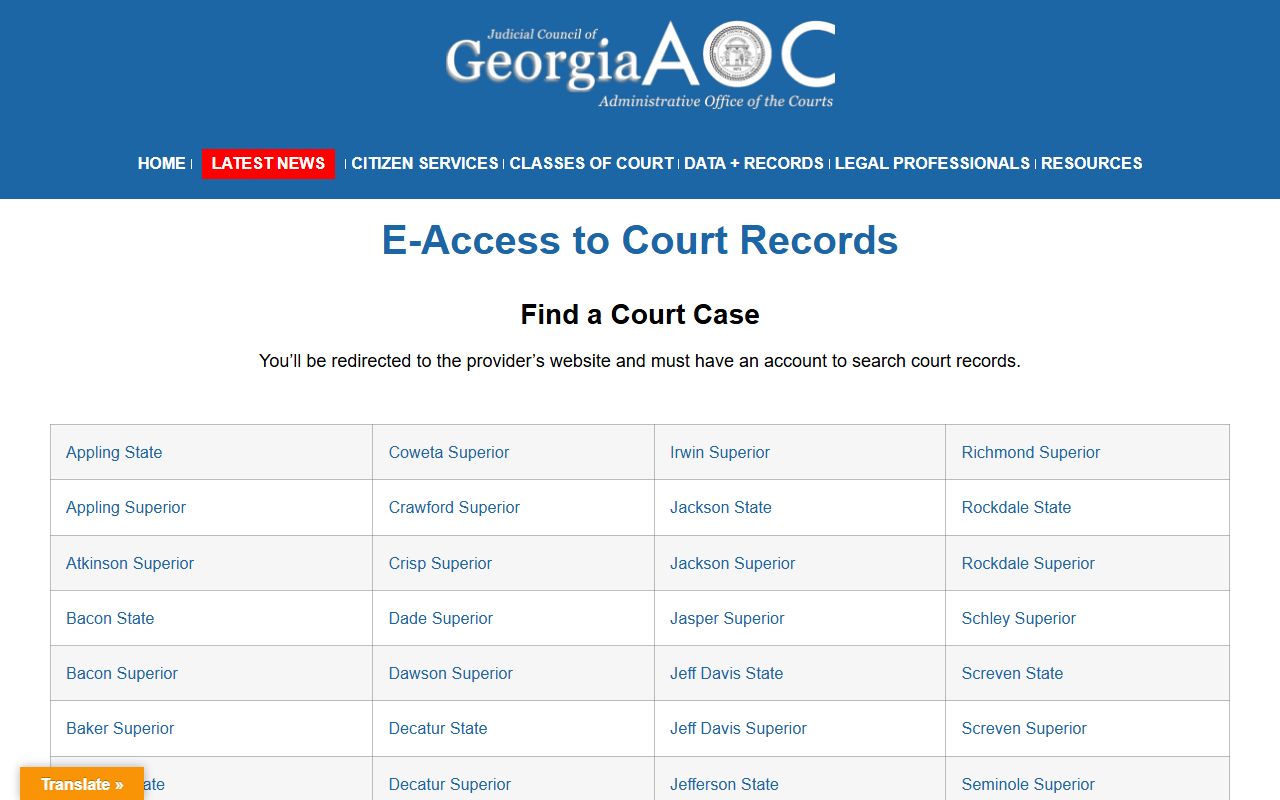
Use the e-access listing as a portal route, then verify case status with the Miller Superior Court Clerk or the right court when a record is incomplete.
| Channel | Use It For | Access Detail |
|---|---|---|
| Georgia e-access / PeachCourt | Existing Miller State or Superior online records | Account required through the provider route. |
| Miller Superior Court Clerk | Criminal case files, filings, warrants, dispositions | (229) 758-4102, 155 S. First St., Room 103. |
| Miller Magistrate Court | First appearance, bond, committal, warrants | (229) 758-4110, 155 S. First St., Room 110. |
| Pataula Judicial Circuit DA | Prosecutor filing and charging status | (229) 724-3011 in Blakely. |
| Miller County Sheriff's Office | Arrest, booking, custody, and bond status if releasable | (229) 758-3421, jail direct (229) 758-3636. |
Arrest To Miller County Court Case
The local process usually runs in this order: arrest, jail booking, first appearance, prosecutor review, formal filing, court hearings, then disposition. The booking stage creates the custody record required for people committed to the county jail. First appearance and bond questions usually point to Magistrate Court. Felony filings and many later criminal case records point to Superior Court and the clerk. The Pataula Judicial Circuit District Attorney is the office that turns arrest reports and probable-cause material into filed charges when prosecution goes forward.
- Start with the custody fact. Call Miller County Jail or the Sheriff's Office to ask whether the person is still in custody, released, or transferred.
- Check Magistrate Court for first appearance, bond, warrant, and committal hearing questions tied to the arrest.
- Search Georgia e-access and PeachCourt for Miller State or Superior case records when an account route is available.
- Contact the Superior Court Clerk for criminal case filings, criminal warrants, and disposition records.
- Use the Pataula Judicial Circuit District Attorney route for prosecutor filing status when the case has moved past initial booking.
Timing can affect results. A very recent arrest may have a jail record before an online court entry exists. A prosecutor may file charges that differ from the arrest charge. A case may also move from a first-appearance or warrant setting into Superior Court after review. When the court records after a Miller County jail arrest do not match the booking text, treat the court file as the place to confirm filed charges and outcomes.
Miller County Charging Records
A charging document is the written record that tells the court what the prosecution is asking the court to handle. It is not the same thing as a booking line. The complaint, information, or indictment may use different wording, add or reduce counts, or narrow the legal basis for the case. In Miller County, the District Attorney serves the Pataula Judicial Circuit, which includes Miller, Clay, Early, Quitman, Randolph, Seminole, and Terrell counties. The DA's office is listed at 12850 Magnolia Street, Blakely, GA 39823, with phone (229) 724-3011.
| Document | Who Uses It | What It Means After Arrest |
|---|---|---|
| Complaint | Law enforcement or prosecutor | Starts or supports a lower-level criminal accusation and may be tied to warrant or first-appearance records. |
| Information or accusation | Prosecutor | States the filed charge without a grand-jury indictment where Georgia procedure allows it. |
| Indictment | Grand jury | Formal felony charge returned by a grand jury and filed into the court record. |
A person can be arrested on one description and later face a different filed count. That does not mean the original jail record was necessarily wrong. It means the case moved from arrest facts into legal charging decisions. For that reason, court records after a jail arrest should be read by date and stage. The earliest jail entry is useful, but the filed court document and the later disposition carry the case result.
Miller Arrest Bond Records
Miller Magistrate Court is the key local office for first appearance and bond. The official county Magistrate Court page lists criminal jurisdiction for arrest warrants, search warrants, first appearance hearings, bond hearings, extradition hearings, committal hearings, warrant application hearings, and certain ordinance or misdemeanor matters. The court is listed at 155 South First Street, Courthouse Room 110, Colquitt, GA 39837, with phone (229) 758-4110 and weekday office hours from 9:00 a.m. to 5:00 p.m.
| Bond Type | Plain Meaning | Miller County Checkpoint |
|---|---|---|
| Cash bond | Money is posted to secure future court appearance. | Call the jail or court before going because payment methods were not published. |
| Surety bond | A licensed bonding company guarantees appearance for a fee. | No local approved bondsman list was located in official sources. |
| Property bond | Real property may secure release where accepted. | Ask the court or jail about local procedure. |
| Recognizance bond | Release is based on a signed promise and conditions. | This is a judicial decision, not a jail-staff guarantee. |
| No-bond hold | Release is blocked until a court or another agency acts. | Ask whether a warrant, probation, parole, federal, ICE, or transfer hold exists. |
A bond amount does not always mean a person will leave Miller County Jail right away. A detainer is a notice or hold from another agency that has a custody interest. A federal warrant, ICE issue, probation or parole hold, another county warrant, or state-prison transfer hold can keep a person in custody even after one charge has a bond.
Miller County Warrant Records
No official Miller County active-warrant online search was located. That makes the sheriff and courts the practical route for warrant questions. The Sheriff's Office processes court orders and can address custody or sheriff-held warrant questions where information is releasable. Magistrate Court issues arrest and search warrants and conducts warrant application hearings. The Superior Court Clerk maintains criminal warrants and criminal case records. PeachCourt or Georgia e-access may help once the warrant connects to a court case, but it should not be treated as a complete warrant list.
- Arrest warrant
- A judge-authorized order to arrest a person based on a criminal accusation or probable cause.
- Bench warrant
- A court warrant often tied to failure to appear or violation of a court order.
- Search warrant
- An order allowing a search of property or a place. It is not a custody roster by itself.
- Hold warrant
- A warrant or detainer from another agency that can keep a person in custody or trigger transfer.
When a warrant leads to a Miller County jail arrest, the booking record and court records can appear in different places. Confirm custody with the jail first. Then check Magistrate Court, the Superior Court Clerk, or PeachCourt for the court side of the warrant.
Miller Court Charge Status
Charge status is the part of the court record that tells whether each filed count is still active, changed, or resolved. Georgia court records after an arrest can show a charge as pending while hearings continue, amended if the wording or count changes, reduced if the charge level drops, dismissed if the court or prosecutor ends the count, or nolle prossed when the prosecutor elects not to proceed. A plea, verdict, acquittal, sentence, or other disposition is the later result.
| Status | What It Means | Why It Matters |
|---|---|---|
| Pending | The charge is open and not yet finally resolved. | Court dates, bond, and conditions may still apply. |
| Amended | The filed charge wording or count changed. | The arrest charge may no longer match the court charge. |
| Reduced | The charge was lowered to a lesser offense or level. | Penalty range and court handling may change. |
| Dismissed | The charge was ended by the court or prosecution. | It is not a conviction, but the record may still exist unless restricted. |
| Nolle prosequi | The prosecutor chose not to continue that count. | The phrase is often shortened to nolle prossed in Georgia records. |
| Convicted | A guilty plea or verdict resolved the charge. | The conviction is different from the earlier accusation. |
Charges Versus Convictions
A Miller County arrest does not equal a conviction. A charge is an accusation filed or carried in a case. A conviction follows a guilty plea, guilty verdict, or other court result that legally establishes guilt. The difference matters for job, housing, licensing, immigration, and personal safety decisions, but this kind of public lookup is not a consumer report. Any formal screening decision must use a lawful, FCRA-compliant process.
| Point | Charge | Conviction |
|---|---|---|
| Stage | Accusation after arrest or filing. | Final result after plea, verdict, or court finding. |
| Proof | Based on probable cause or charging decision. | Requires the legal standard for guilt. |
| Record source | Jail, warrant, prosecutor, or court filing. | Court disposition and sentence record. |
| Can change? | Yes, charges may be amended, reduced, or dropped. | Can be appealed, corrected, or restricted only through legal process. |
Important: Public case lookups may be incomplete or stale and are not a substitute for an official court disposition.
Restricted Miller Court Records
Georgia uses the term record restriction for many criminal-history access limits. The Georgia Bureau of Investigation describes restriction as limiting public access to qualifying criminal history records for non-criminal-justice purposes. A dismissed charge, no prosecution, acquittal, or other favorable outcome does not always vanish from every court or jail file on its own. The person may need to follow the Georgia restriction process or the court's order process, depending on the record and outcome.
| Concept | Georgia Meaning | Practical Effect |
|---|---|---|
| Restricted | Public criminal-history access is limited for qualifying records. | Criminal justice agencies may still have access. |
| Sealed | Court access is limited by law or order. | The public may not see some filings or details. |
| Expunged | A common term, but Georgia generally uses restriction language. | Do not assume a record is destroyed unless an order or law says so. |
Juvenile matters, sealed filings, protected personal data, ongoing investigations, and records restricted by court order may not appear through public portals. The Georgia Open Records Act also permits redaction or withholding when another statute or court order applies. When a Miller County court record after an arrest appears missing, check whether the case is too new, in a different court, restricted, or held only by the clerk.